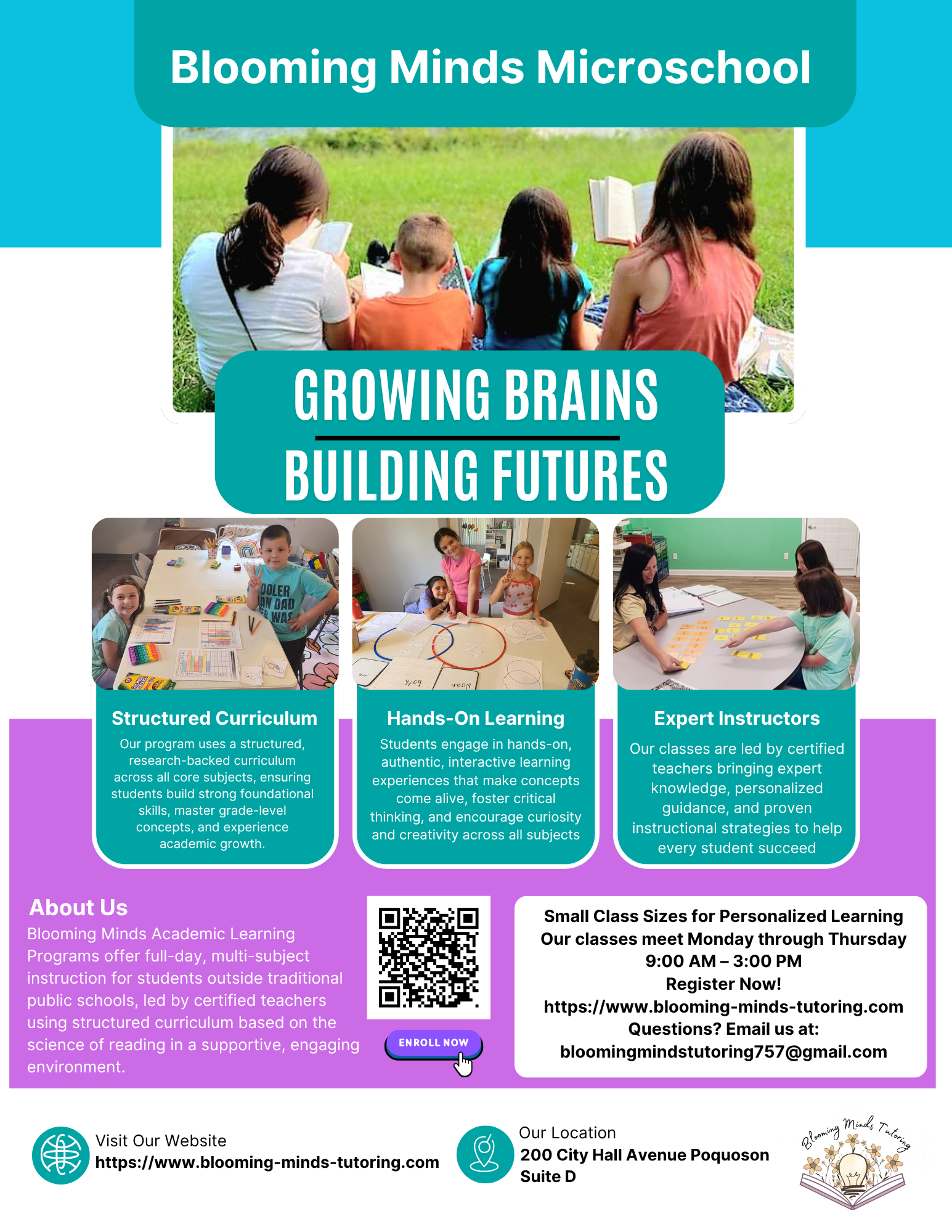
Microschool Learning: A New Path Forward
Where students learn deeply, grow confidently, and truly thrive
At Blooming Minds, we are proud to launch our MICROSCHOOL for the 2026-2027 school year!
Created to inspire growth, build confidence, and help every student reach their full potential through personalized, engaging instruction.
Our program offers a unique learning experience focused on student growth and development at an individualized pace. Students benefit from structure and a research-based curriculum while engaging in hands-on, high-interest, project-based learning that makes education exciting and meaningful.
Class Schedule:
Monday–Thursday | 9:00 AM – 3:00 PM
August 24th - June 4th
Program Fees
Registration Fee: $100
One-time annual fee per student
Curriculum Fee: $300
One-time annual fee per student
Monthly Tuition (per student):
$450 – 2-day program
$750 – 4-day program
Ready to Sign Up?
Spots are limited, so don’t wait! Give your child the opportunity to learn, grow, and thrive in a fun, hands-on, project-based environment.
Frequently Asked Questions
-
A: Classes are held Monday through Thursday, 9:00am to 3:00om. We offer both 2-day hybrid options and 4-day full-time options. Days of attendance are determined during registration and finalized after an assessment of each student’s academic skills, learning needs, and individual goals. These classes focus on general grade-level skills, so students do not need to be in that grade specifically—any student who is working at the appropriate skill level can attend. Our learning program provides targeted instruction and enrichment for students in Grades 1–5. All classes are taught by fully qualified, state-verified teachers with degrees, ensuring that your child receives high-quality, professional instruction in a safe and structured environment.
-
A: No, our classes are completely secular. They are drop-off academic sessions, not a co-op. Parents drop students off at the start of class and pick them up at the end—there is no requirement to volunteer or participate in teaching.
-
A: Classes are structured to give students focused academic instruction in a small-group setting. Core subjects covered include math, science, reading, and writing, and each lesson incorporates supplemental STEM activities and authentic, hands-on learning experiences that allow students to apply content in real-world ways. Activities include guided practice, skill development tailored to each student’s level, and opportunities to actively engage with concepts, making learning meaningful and memorable.
-
A: Research-Backed Curriculum
Our program uses the Science of Reading and evidence-based strategies to provide comprehensive instruction in literacy, mathematics, science, and social studies. Every lesson is designed to support mastery, critical thinking, and a love of learning. We use a variety of high-quality, structured online programs to further support independent learning:
Teaching Textbooks – Math instruction and practice
Lexia – Literacy and reading support
Reflex – Math fluency and fact practice
IXL – Skill-based practice in multiple subjects
Handwriting – Fine motor skills and written expression
These resources are combined with teacher-led instruction to ensure that students are engaged, challenged, and making measurable progress.
-
A: Drop-off and pick-up occur at 200 City Hall Avenue, Suite D, Poquoson. Our staff will greet students and ensure they get to class safely. Classes run from 9:00 a.m. to 3:00 p.m. on your student’s scheduled attendance days.
-
A: Our program is designed as drop-off only. Parents are free to leave once class begins, allowing students to focus fully on learning while in a supervised, structured environment.
-
A: Our program fees include:
Registration Fee: $100 (one-time annual fee per student)
Curriculum Fee: $300 (one-time annual fee per student)
Monthly Tuition per student:
$450 for the 2-day program
$750 for the 4-day program
-
A: Yes. In accordance with Virginia requirements:
Parents must submit a Notice of Intent by the required date to enroll their child.
Parents are required to provide proof of progress for their children who are between the ages of 6 and 18 as of September 30th of the current school year. This requirement is part of the Home Instruction Statute §22.1-254.1 in Virginia. Parents must submit evidence of progress by August 1st following the school year in which the child has received instruction.
Progress monitoring occurs throughout the program to ensure that students are making measurable growth in their academic skills.
Our teachers track progress closely and communicate updates as needed, so parents are informed of their child’s growth and areas for improvement. When it is time to submit proof of progress, our team will guide and support families through the process, helping you understand what is needed and ensuring documentation is clear and appropriate.
More information can be found at:
https://www.doe.virginia.gov/parents-students/for-parents/home-instruction
-
A: To participate fully, each student should bring:
A device – Laptop or computer for digital learning programs and activities
Lunch and snack – Students need food for breaks to stay energized and focused
Water Bottle
Having these items daily ensures students can fully engage with the curriculum and hands-on activities without interruption.
-
A: Yes! We offer optional extracurricular experiences to enhance learning, including:
Biweekly walking trips to the library
Guest speakers on various topics
Occasional field trips (may include extra fees and transportation)
Parents will always be notified in advance, and participation is completely optional. These activities are designed to give students real-world exposure and enrichment while complementing their academic learning.
-
A: Student progress is closely monitored throughout the program using:
Pre-assessments and placement tests – to determine each student’s skill level and place them appropriately
Ongoing progress monitoring – to track growth and provide targeted support
Take-home practice – On days when students are not in session, optional take-home work may be assigned to practice skills or review previous concepts
-
A: Yes! We will host pre-assessment and device setup sessions prior to the first day of class the week of August 17th. This allows:
Students to complete pre-assessment testing
Families to set up required devices
Parents to ask questions and meet teachers
These sessions help ensure that each student starts the program prepared and confident.
-
A: Yes! We are happy to schedule a tour and introduction session. During the visit, you can:
See the classroom and learning environment
Meet the teachers
Ask questions about the program, curriculum, and schedule
Tours help families feel confident that Blooming Minds is a safe, engaging, and supportive place for their child to learn.
-
A: The program will run from August 24th - June 4th Mondays to Thursdays, including breaks for:
Winter holiday break
Spring break
Other key holidays
Bad weather days will be determined by the facility on a case-by-case basis, and parents will be notified in advance of any closures or changes.
-
A: Students receive direct, explicit instruction from a certified teacher in the core content areas of literacy, math, social studies, and science.
While some content includes the use of computers, we intentionally limit technology time. Instead, students engage in:
Hands-on learning experiences
Real-world application of skills
Group collaboration and cooperative projects
This approach ensures students are actively learning through meaningful, engaging experiences.
-
A: In addition to academic instruction, students develop:
Executive functioning skills
Planning and organization
Problem-solving strategies
Socialization and cooperation skills
These skills support both academic growth and real-world success.
-
A: Our program takes a student-centered, mastery-based approach that focuses on both continuous improvement and overall academic growth and development.
We:
Focus on mastering concepts before moving on, while keeping long-term academic progress in mind
Connect content areas to help students understand real-world problems and apply their learning meaningfully
Spend less time on testing and grading and more time assessing learning through hands-on experiences and observation
Tailor instruction to each student’s specific needs rather than teaching strictly to a whole group
Hold students accountable while allowing them to progress at a developmentally appropriate pace
Use multiple learning styles so students can access content in ways that work best for them
Maintain small class sizes, which allows for a more personalized learning experience and stronger teacher-student connections